The short answer
In Concord in 2026, removing a tree costs between about $300 and $7,500. A small ornamental or a Bradford pear in the open is $300 to $750. A medium oak, poplar or pine, 25 to 50 feet, with room to drop it is $700 to $1,600. A large water oak, willow oak or tulip poplar, 50 to 80 feet, near the house, deck or power drop is $1,700 to $4,200 rigged down in sections. Trees that need a crane — over the roof, on a tight historic-district lot, or too rotten to climb — run $2,800 to $7,500. Stump grinding adds $100 to $500.
Prices by size
| Tree | 2026 price | What's typical |
|---|---|---|
| Small tree, under 25 ft, open access | $300 – $750 | Bradford pear, dogwood, crape myrtle, Leyland cypress |
| Medium tree, 25–50 ft, room to drop | $700 – $1,600 | Pine, red maple, young oak in an open yard |
| Large tree, 50–80 ft, near structures | $1,700 – $4,200 | Water oak or poplar over the house, rigged |
| Very large or over the house | $2,800 – $7,500 | Crane-assisted |
| Tall loblolly pine, 70–100 ft | $1,200 – $2,600 | Higher near the house; groups are cheaper per tree |
| Stump grinding | $100 – $500 | Per stump, by diameter |
| City / HOA paperwork (when required) | Usually not needed | Most single-family yard trees involve none |
What moves the price
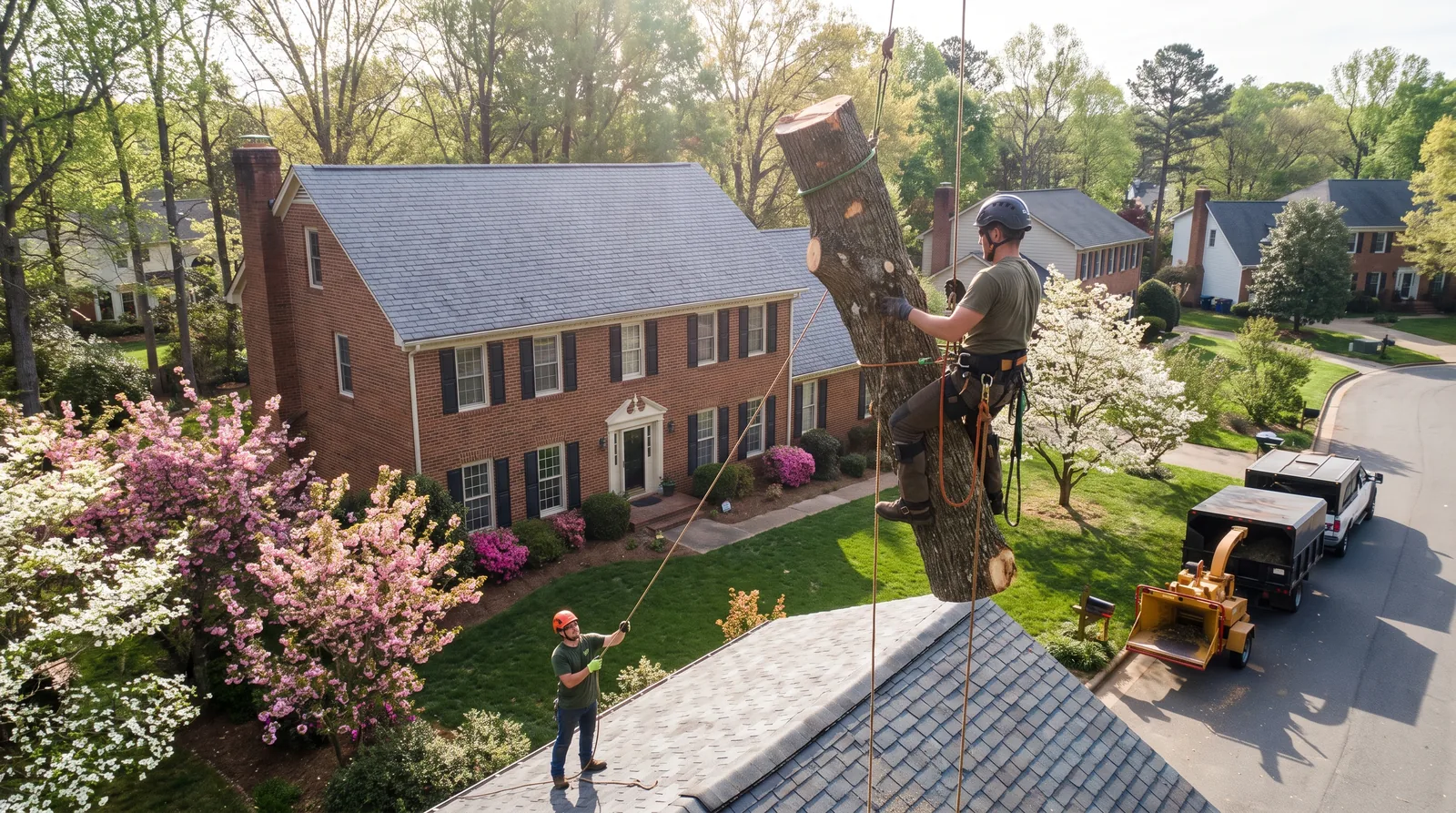
What's under it. A tree that can be felled in one piece is a two-hour job. The same tree over a roof, a deck, a fence, a neighbor's driveway or the service drop has to come down in fifty pieces on ropes, or by crane, and that's a day. This is the single biggest factor in Concord's older neighborhoods, where the mill-village lots are narrow and most big oaks are twenty feet from the house.
Species and condition. Water oaks are heavy and often hollow, which makes them slower and riskier to climb than a pine of the same height. A dead or beetle-killed tree can't be climbed safely and goes to the crane. Bradford pears and Leylands are quick.
Access. A bucket truck that can park in the driveway or the street saves hours. A back-yard tree behind a fence with no gate wide enough for equipment means hand-carrying every piece — or a crane reaching over the house.
Season. After a county-wide storm, demand spikes and so do prices from crews that follow storms. Our rates don't change, but our schedule fills; the same removal booked in a quiet month is scheduled faster.
The stump. Grinding is priced separately, by the inch of diameter. Leave it, grind it, or have it pulled if a foundation is going in.
What a real quote should include
An itemized price for the removal itself, any crane or specialty rigging, hauling and cleanup, stump grinding (or a note that it's excluded), any paperwork, and the crew's certificate of insurance. It should be in writing, good for a stated period, and it should say what happens to the wood. If a "quote" is a number shouted from the truck window, keep shopping.
Common questions
Why did I get quotes of $900 and $3,500 for the same tree?
Usually because one crew plans to drop it and the other plans to rig it — and only one of those is safe over your house. Ask each company how they'd take it down and whether they're insured for the man in the tree. The low number sometimes includes neither a rigging plan nor workers' comp.
Is it cheaper to remove several trees at once?
Yes. The setup — truck, chipper, crew, crane if needed — is the expensive part. A back-line screen of six pines is priced far below six separate visits, and sharing a crane day with a neighbor cuts the crane cost in half.
Do you charge for the estimate?
No. On-site estimates are free anywhere in our service area. A written arborist assessment with a report is $150 to $300, credited against any work you book.
Can I save money by cutting it up myself after you drop it?
On an open-lot tree, sometimes — we'll drop it and leave it, and you handle the bucking and hauling. On anything near a structure the rigging is most of the cost and there's no shortcut worth taking.
Related: Tree removal · Crane removal · Stump grinding · Do you need a permit?