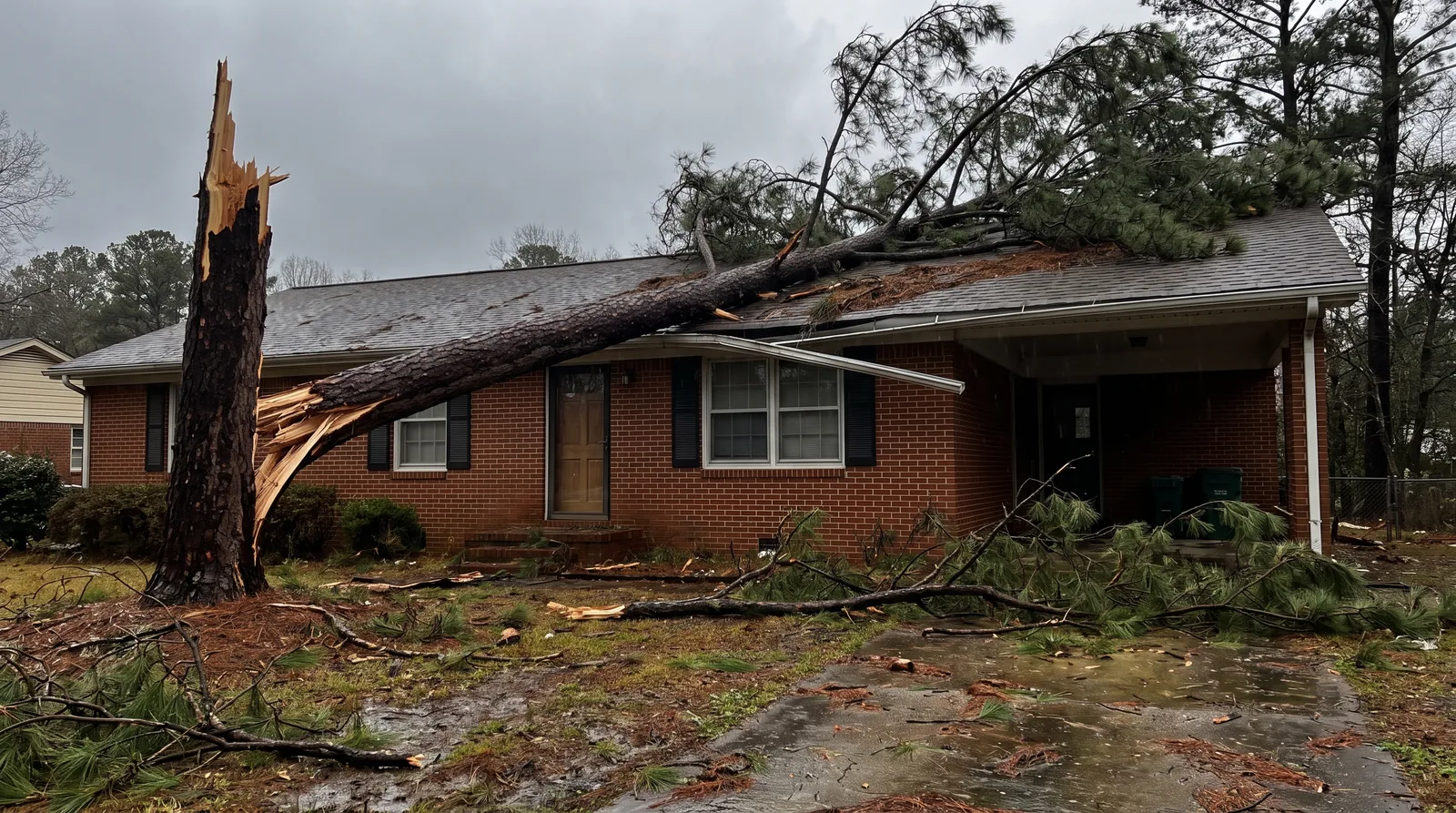
The three ways Concord trees fail
Ice. Freezing rain adds weight fast — a half-inch of ice can multiply a limb's load thirty-fold. The trees that break are the ones with weak unions and lots of fine branching to hold ice: Bradford pears, Leyland cypresses, loblolly pines with heavy crowns, and any tree that's been topped and grown back a mop of weak shoots. The December 2002 storm put roughly 1.8 million Carolinas customers in the dark; February 2014's Winter Storm Pax did it again; January 2025's snow and ice loaded the same species one more time.
Wind on wet ground. Cecil clay saturates in a wet winter and holds water for weeks. When a soaked root plate meets a 50-mph gust, shallow-rooted trees — loblolly pines above all — lever over at the roots and come down full length. Hugo did it on September 22, 1989, with hurricane-force gusts over the Charlotte area; Helene's remnants did it on September 27, 2024, after Debby's rain in August had already soaked the ground.
Summer limb drop. Thunderstorm downbursts and hot, still afternoons take big limbs off water oaks, tulip poplars and silver maples. These aren't rare events — they're most Julys.
What actually helps
An inspection. The single most valuable thing you can do is have an arborist look at the trees near the house every few years and tell you which ones are the problem. Decay at the base, a codominant union with included bark, a new lean, soil heave, a dead crown — those are the trees that fail.
Crown cleaning and thinning. Deadwood out, crossing limbs corrected, and a modest thinning so wind passes through the crown instead of pushing on it like a sail. Done to ANSI A300, no more than about a quarter of the live crown.
Cabling. A valuable oak or maple with one weak union gets a support cable, which carries the load through an ice storm that would otherwise split it.
Removing the right trees. Water oaks with decay over the house, leaning pines with heaved soil, Bradford pears over the driveway, brown Leylands ten feet from the siding. Taking these on your schedule costs a fraction of taking them off the roof.
Keeping the ten feet. Trees growing into the service drop get trimmed by us; trees into the primary lines get reported to Concord Electric Systems or Duke Energy, whose line-clearance crews handle them. The city code only allows ornamental species within 15 feet of an overhead line for a reason.
What doesn't help
Topping. Cutting a tree back to stubs produces dozens of weak, fast shoots that break in the next ice storm and rots the cut ends. It makes a tree more dangerous within a few years, not less.
Lion-tailing. Stripping all the interior branches and leaving tufts at the ends moves the weight to the tips and makes limbs snap. It's common and wrong.
Piling mulch on the trunk. A mulch volcano rots the root flare and invites the decay that makes a tree fail. Two to three inches of mulch, kept off the trunk.
Waiting for the forecast. By the time the ice-storm warning is out, every crew in the county is booked. Winter pruning in November and December is the time to do this work.
Before the storm
Photograph your trees and the house from a few angles — it makes an insurance claim much easier. Know who your electric provider is (Concord Electric Systems inside its city territory, Duke Energy elsewhere) and how to report an outage. Have our number where you can find it in the dark.
Common questions
When should I have storm pruning done?
Dormant season — November through February — is ideal for oaks and most shade trees, and it's before the worst of the ice. Summer is fine for dead-limb removal. After a storm warning is posted is too late to get on any competent crew's schedule.
Will topping my tall trees make them safer?
No. It's the most common storm 'preparation' we see and it makes things worse: weak regrowth, decay at the cuts, and a tree that's more likely to shed limbs. If a tree is genuinely too tall for its spot, reduce it properly to lateral branches or remove it.
Should I remove all the pines behind my house?
Not all — the leaning ones, the ones with heaved soil or beetle damage, and the ones standing alone after neighbors were cut. A healthy loblolly in a stand is usually fine. Our arborist will walk the line with you and mark the ones that matter.
Do you offer a pre-storm inspection?
Yes. A walk-through with our arborist and a written list of what to prune, cable, remove or leave alone, prioritized by risk, is $150 to $300 depending on the property and is credited against the work.
Related: Emergency tree service · Tree trimming · Cabling & bracing · Pine removal